Technical Explainer / Portfolio Sample

How an air conditioner works,
explained simply with diagrams

"How does an air conditioner actually cool a room?" — explained so that anyone, with no technical background, can follow. A portfolio sample.

This is a portfolio sample (a general-audience demo). It is meant to show how clearly a technical topic can be turned into an illustrated document. It is not tied to any specific product, company, or client work, and every figure is an original AI-generated image.

1. What is it actually doing?

2. The whole system (indoor & outdoor units)

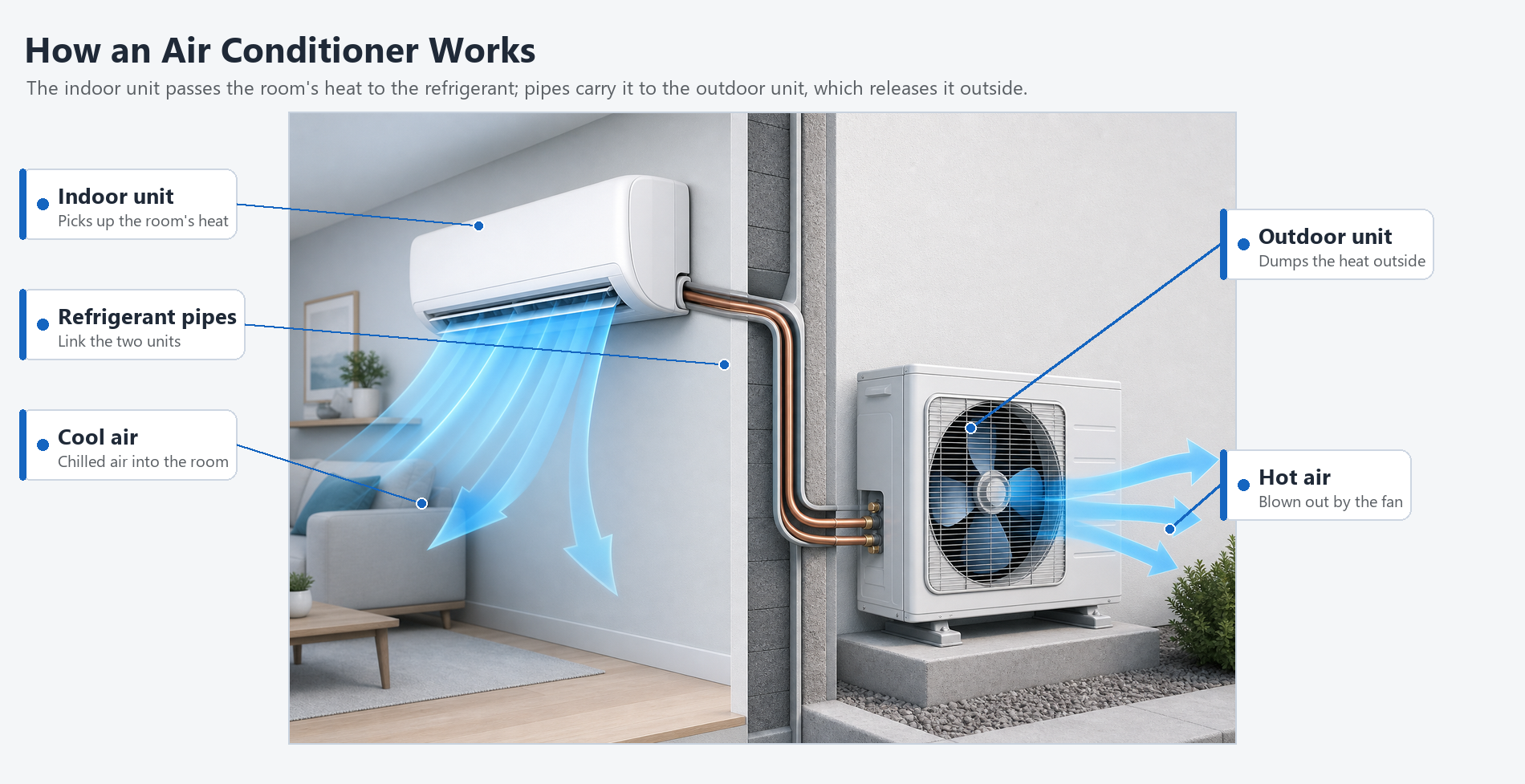
Diagram of an air conditioner: the indoor unit passes the room's heat to the refrigerant, which travels through pipes to the outdoor unit that releases the heat outside.
Fig. 1 — Indoor unit, refrigerant pipes, and outdoor unit
3. The cooling cycle (4 steps)

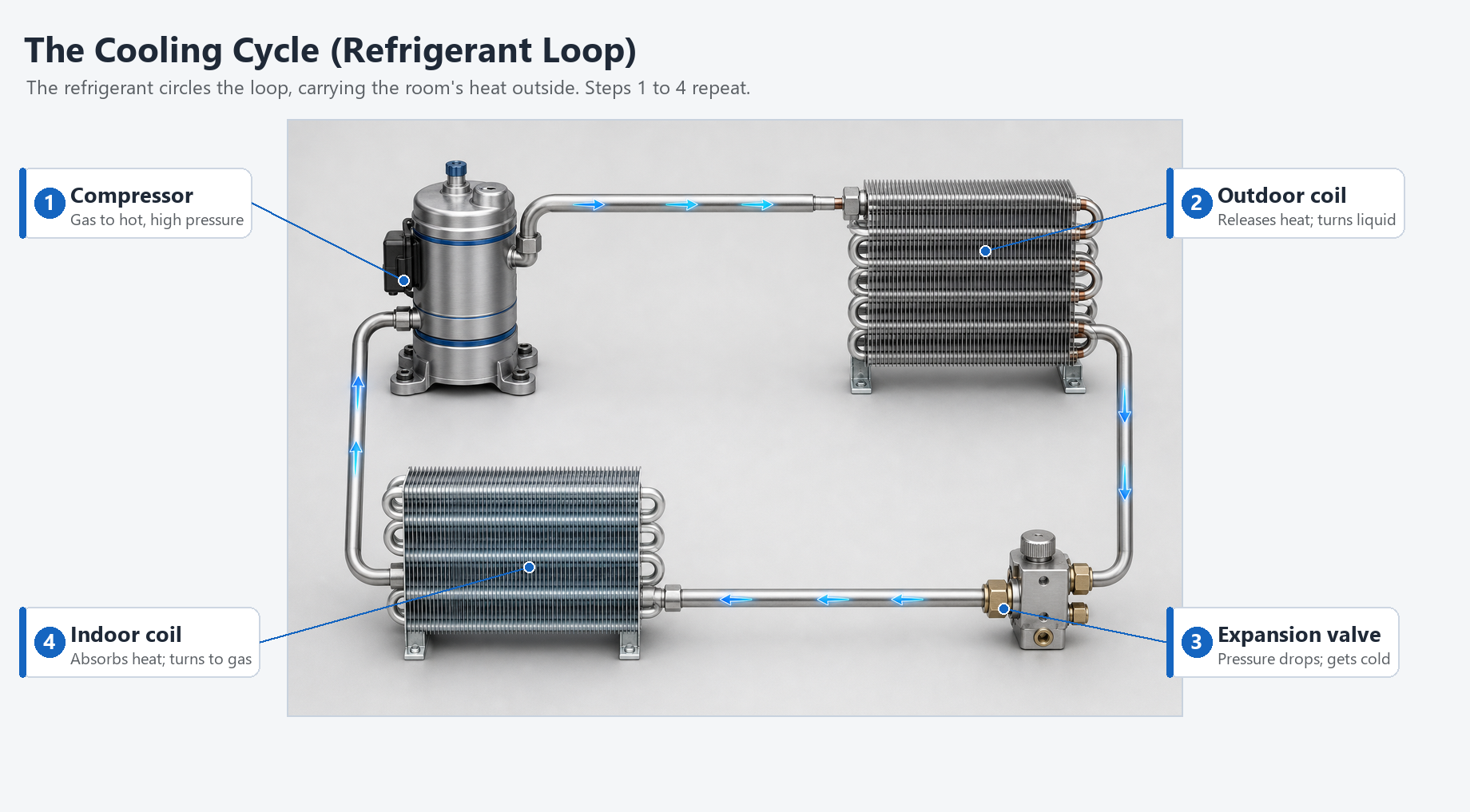
The refrigerant loops through compressor, outdoor coil, expansion valve, and indoor coil, carrying the room's heat outside in four steps.
Fig. 2 — The refrigerant loop (1 compress → 2 release → 3 expand → 4 absorb)
  1. The compressor squeezes the low-temperature gas into a hot, high-pressure gas.
  2. The outdoor coil releases heat into the outside air, and the refrigerant turns to liquid.
  3. The expansion valve drops the pressure, making it cold and low-pressure.
  4. The indoor coil absorbs the room's heat, turns back to gas, and cool air is blown out (back to step 1).

4. Main parts and their roles

PartRole (in plain terms)
CompressorA pump that squeezes the refrigerant to keep it circulating — the "heart" (inside the outdoor unit).
Outdoor coil (condenser)Releases the heat the refrigerant carried into the outside air.
Expansion valveDrops the pressure sharply, making the refrigerant cold.
Indoor coil (evaporator)Lets the refrigerant absorb the room's heat and blows out cool air.
FanMoves air across the coils to help heat flow in and out.

5. Good to know

PointWhy it matters
It heats, tooReverse the refrigerant flow and it carries outside heat into the room (a heat pump).
Key to efficiencyAn inverter fine-tunes the compressor's speed to cut wasted electricity.
Clean the filterDust clogs the airflow, weakening performance and raising your bill.
Don't overshootSetting the temperature too low or too high uses far more power.

6. Mini glossary

RefrigerantA substance that switches between liquid and gas to carry heat.
CompressorA pump that squeezes the refrigerant to circulate it.
Heat exchangerA part where the refrigerant and air trade heat (in both units).
Condenser / EvaporatorThe heat exchanger that releases heat / the one that absorbs it.
Expansion valveA valve that lowers pressure to cool the refrigerant.
Heat pumpA mechanism that "pumps" heat from one place to another (used for heating).

View it / take it with you

※ Slides are best viewed on a desktop (they may be hard to read on mobile).